Stolen Session Cookies: How Attackers Are Bypassing Your MFA in 2026
Multi-factor authentication was supposed to be the control that finally stopped account takeovers. For years, "just turn on MFA" was the single best piece of security advice you could give a small business. It is still essential — but in 2026, attackers have found a reliable way around it that most business owners have never heard of, and it has quietly become one of the most common ways accounts get breached.
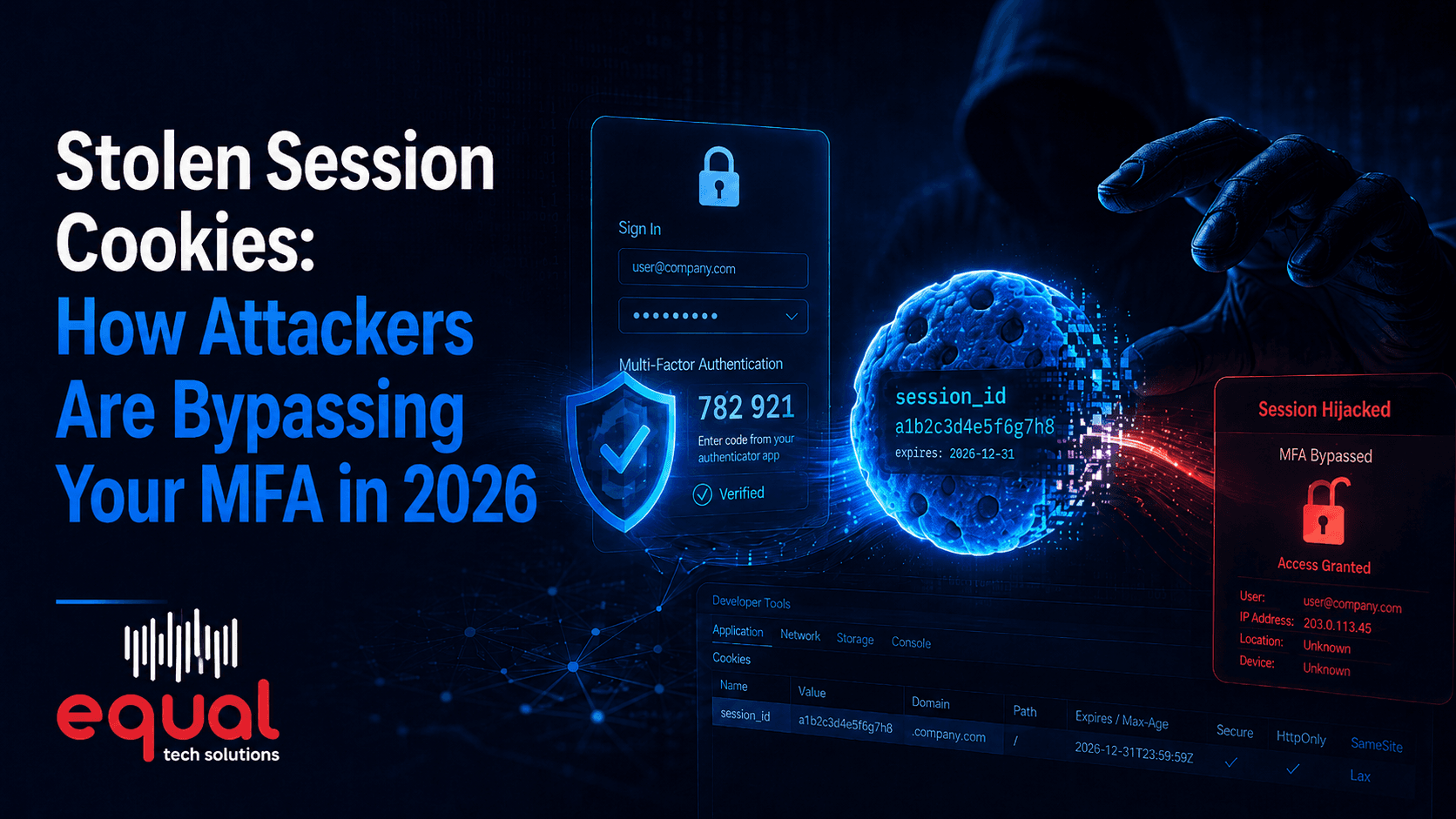
The technique is called session hijacking. It works by stealing the digital "session cookie" your browser holds after you log in — not your password, and not your MFA code. Here is what is happening, why it defeats MFA, and what actually stops it.
What is a session cookie — and why do attackers want it?
When you log into Microsoft 365, Google Workspace, your bank, or any modern web app, the site checks your password and your MFA code once. After that, it hands your browser a small token — a session cookie — that says "this person is already authenticated, don't ask again." That cookie is what keeps you logged in as you move between pages and come back the next morning without re-entering everything.
Here is the problem: whoever holds that cookie is treated as you — no password or MFA required. If an attacker copies your active session cookie onto their own machine, they walk straight into your account, having skipped the password and the MFA prompt entirely.
How attackers steal your session in 2026
Two methods dominate right now, and both are cheap and widely available to even low-skill criminals.
1. Adversary-in-the-Middle (AiTM) phishing
Instead of a fake login page that just records your password, modern phishing kits — sold as ready-made services — sit invisibly between you and the real Microsoft or Google login. You click a link, you see the genuine login page (because the kit is relaying it in real time), you type your password, and you approve the MFA push on your phone. Everything looks normal and you get logged in. But the kit silently captures the session cookie the real site issues. The attacker now owns your authenticated session. You did everything "right" — including approving MFA — and they still got in.
2. Infostealer malware
Infostealers are cheap, fast malware with one job: scrape everything valuable off a computer — saved passwords, browser session cookies, crypto wallets — and ship it to the attacker in seconds. People get infected through a malicious download, a fake software update, a cracked app, or a poisoned search result. The stolen data is bundled into "logs" and sold in bulk on criminal marketplaces, and a single infected laptop can hand over dozens of live business session cookies at once.
This is now an industrial-scale economy. Millions of infostealer logs are traded every month, and many contain active corporate session tokens for Microsoft 365, VPNs, and banking portals.
Why this is so dangerous for small businesses
- It defeats your strongest control. Most small businesses treat MFA as the finish line. Session theft jumps over it.
- It is silent. There is no failed-login alert and no password-reset email — the attacker is riding a legitimate, already-approved session.
- It is fast and scalable. Stolen sessions are sold in bulk, so an attacker does not need to target you specifically to end up inside your tenant.
- It leads straight to the expensive attacks. Business email compromise, wire fraud, ransomware, and data theft all routinely start with one stolen session.
What actually stops session hijacking
The good news: this is defendable, and most of the defenses are pieces a well-run IT program already has. Here is what we deploy for clients.
- Phishing-resistant MFA (passkeys and FIDO2 security keys). Unlike a code or a push notification, a passkey is cryptographically tied to the real website — it simply will not authenticate against an AiTM phishing proxy. This is the single most effective fix.
- Conditional Access and token protection. Policies that bind a session to a known, compliant device and expected location, so a stolen cookie replayed from an unknown machine in another country gets blocked.
- Shorter session lifetimes and continuous re-evaluation for sensitive accounts, so a stolen cookie has a far smaller window to be useful.
- Managed EDR / MDR on every endpoint. Infostealers are malware — modern endpoint detection catches and kills them before they can exfiltrate cookies, and a monitored response shuts down anything that slips through.
- Dark web and infostealer monitoring. Knowing the moment your domain appears in a fresh infostealer log lets you force-revoke sessions and reset credentials before the attacker uses them.
- Security awareness training. AiTM still starts with a click. Employees who pause on unexpected login prompts and "please re-authenticate" requests remain your first line of defense.
The takeaway
MFA is not obsolete — turning it off would be a serious mistake. But in 2026, "we have MFA" is no longer the same as "we are protected from account takeover." Attackers have moved past it, and your defenses need to as well: phishing-resistant logins, device-aware access policies, real endpoint protection, and monitoring that catches a stolen session before it becomes a wire-fraud or ransomware headline.
Find out if your business is already exposed
Stolen credentials and session data from your domain may already be circulating. You can check right now, for free, with our Free Cyber Scan — it checks your email or domain against known breach and infostealer data in seconds. If you would like a human to review your Microsoft 365 and identity setup for exactly the gaps described above, see our cybersecurity services or talk to a senior engineer at Equal Tech Solutions — no sales pitch, just a straight answer on where you stand.